
Learn how to write a clear, structured discussion section for research papers, including how to write a discussion section effectively. This practical 3-step framework helps you move from results to meaning—especially when reviewers say your discussion is weak or descriptive.
One of the most common reviewer comments in academic publishing is painfully familiar:
“The results are interesting, but the discussion is weak.”
Or worse:
“The discussion is largely descriptive.”
If you have received feedback like this, the problem is usually not your English, and often not even your data.
In most cases, the real issue is that the discussion section lacks a clear structure.
Many authors—especially early-career and non-native writers—treat the discussion as an afterthought: something to complete once the results are finished. Reviewers can sense this immediately.
This article explains why discussion sections so often fail, and introduces a simple 3-step framework to structure them more clearly.
Why Discussion Sections So Often Go Wrong
Most weak discussion sections fall into one (or more) of the following patterns:
- They repeat the results in longer sentences
- They turn into a mini literature review, citing everything remotely related
- They restate the introduction with new references
- They describe findings but avoid interpretation
- They hedge every statement until nothing meaningful remains
None of these are language problems.
They are structural problems.
A discussion section is not meant to demonstrate how much you have read or how carefully you phrase each sentence. Its role is far narrower—and far more demanding.
What a Discussion Section Is Actually For
At its core, a discussion section answers one question:
So what?
Not:
- What did you measure?
- How did you analyze it?
But:
- Why do these findings matter relative to what we already know?
- What changes because of them?
If a discussion does not answer these questions clearly, reviewers will describe it as superficial—even when it is technically correct. So, how to write a discussion section?
A Simple 3-Step Framework for Structuring the Discussion
You do not need complex templates or rigid formulas.
What you need is clarity about the job each paragraph is meant to do.
The following 3-step framework works across most empirical papers.
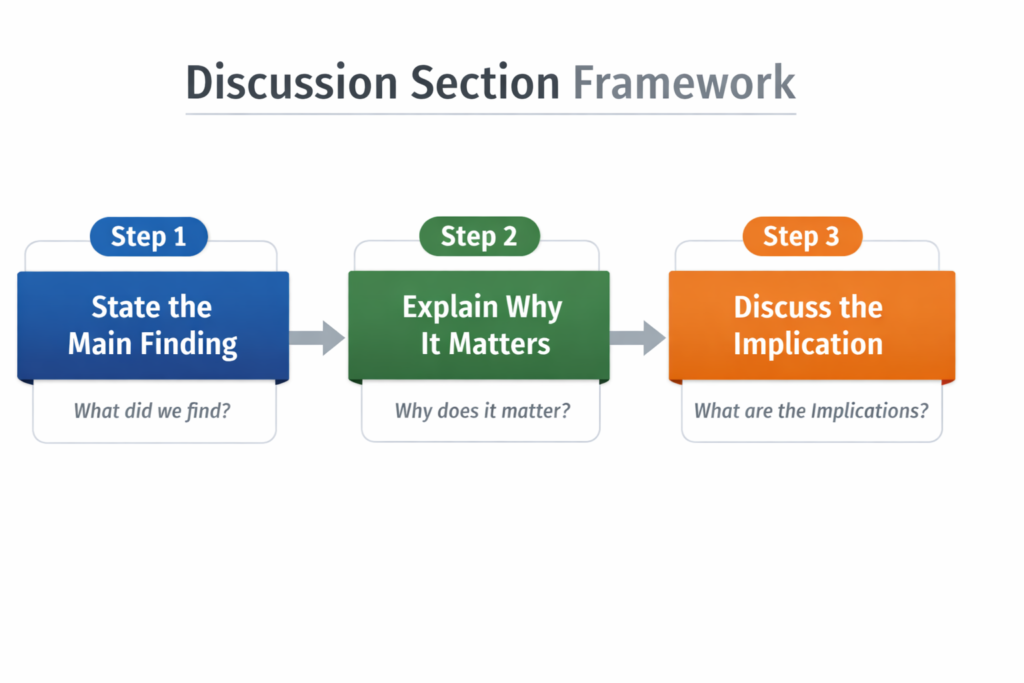
Step 1: State the Main Finding — Once, Clearly
Begin by stating what you found, in one or two sentences.
- No tables
- No detailed statistics
- No p-values
Just the central message.
Bad example:
“In our study, we found that variable A was significantly associated with variable B (p = 0.032), consistent with Table 2.”
Better:
“This study demonstrates that variable A is associated with variable B in [population/context].”
If you cannot summarize your main finding without numbers, the discussion will drift from the very beginning.
Step 2: Explain Why It Matters — In Relation to Existing Work
This is where many discussions collapse.
Authors often feel pressure to cite extensively, which leads to long paragraphs comparing minor details across dozens of studies. This rarely adds depth.
Instead, focus on one or two meaningful comparisons:
- Does your finding confirm existing evidence?
- Does it challenge a prevailing assumption?
- Does it extend prior work to a new population, method, or context?
You are not writing a review article.
You are positioning your result within the literature, not mapping the entire field.
A useful self-check:
If this paragraph were removed, would the reader lose understanding of why the finding matters?
If the answer is no, the paragraph is probably unnecessary.
Step 3: Clarify the Implication — What Changes Because of This?
Every strong discussion makes at least one implication explicit.
Depending on your field, this may be:
- A clinical implication
- A theoretical implication
- A methodological implication
You do not need to claim all three. Choose one, and articulate it carefully.
This does not mean overstating your results. It means being clear about their scope and consequence.
Weak discussions often avoid implications entirely—out of fear of overclaiming or reviewer criticism. Ironically, this avoidance is exactly what triggers critical reviews.
Why Non-Native Writers Struggle Most with Discussions
For many non-native English writers, the discussion section feels especially risky.
Common reasons include:
- Fear of making strong claims
- Fear of sounding “unscientific”
- Fear of contradicting senior authors
- Fear of reviewer pushback
As a result, writers retreat into safe territory:
- Citations instead of interpretation
- Description instead of argument
- Length instead of clarity
Reviewers, however, are not asking for bold language.
They are asking for clear thinking.
A cautious claim with a clear structure is far more persuasive than a long, vague discussion filled with references.
A Final Reality Check
A clear discussion section is not about writing more.
It is about knowing:
- What your main message is
- How it relates to existing knowledge
- Why it matters beyond your dataset
When each paragraph has a defined role, reviewers rarely describe the discussion as weak—even when they disagree with the interpretation.
Depth comes from structure, not volume.
If you are revising a paper and reviewers say your discussion is unclear, try this framework before rewriting everything. Often, clarity improves without adding a single reference—or a single sentence.

Comments
3 responses to “How to Write a Discussion Section”
[…] Discussion sections are structured around what was done rather than what was […]
[…] Editors do not read line by line at first. They scan the abstract, the figures, the section flow, and especially the discussion. […]
[…] this contract changed how I write discussions, interpret reviews, and decide what not to […]