Why Writing Like a Normal Human Doesn’t Work in Academia
For years, I believed my academic writing was poor because my English wasn’t good enough. Only later did I realize that the real issue was not language proficiency, but the basic difference between academic vs everyday writing.
I spent hours to learn grammar (a thick book of Oxford), memorizing academic phrases, reading relevant papers. I edited sentences until they “sounded right.” And, when I submitted my first manuscript, the feedback wasn’t about language errors—it was about clarity.
The problem wasn’t my writing skill is bad, but I was writing the wrong kind of English.
The Two Writing Systems
Most of us write to share experiences, connect with others, tell stories. And in those contexts, we write well enough. But academic writing doesn’t work like that.
If you write an academic paper the way you write everyday English, you are almost guaranteed to sound unclear—not because your English is poor, but because you’re using the wrong operating system. So what is exactly the difference of academic vs everyday writing?
How Everyday Writing Works
Everyday writing assumes shared context.
When I email a colleague saying “the patient from yesterday is doing better,” they know which patient, which problem, what “better” means. When I write a blog post about research struggles, readers fill in gaps with their own experiences. The meaning isn’t just in my words—it’s in the situation we both understand.
This works because everyday readers are:
- Already familiar with the context
- Willing to interpret generously
- Not looking to challenge every claim
- Reading to connect, not to evaluate
A sentence like “the procedure went well” is clear in a clinical note. Everyone knows what procedure, what “well” means in that context, what the baseline expectation was.
Everyday writing tolerates ambiguity because meaning is collaborative. The reader helps complete it.
Academic vs Everyday Writing: Why The Different Matters
Academic writing exists in a hostile environment.
Your reader doesn’t know you. They don’t share your context. They don’t owe you the benefit of the doubt. They’re reading to assess whether your claim holds up—and they will test every weak point.
In a grant proposal, “the procedure went well” means nothing. Well compared to what? By which metric? What does “well” prove about your hypothesis?
The academic reader won’t help you. If your argument has a gap, they’ll notice it. If your claim is vague, they’ll reject it. If your logic depends on an assumption you didn’t state, they’ll mark it as unclear.
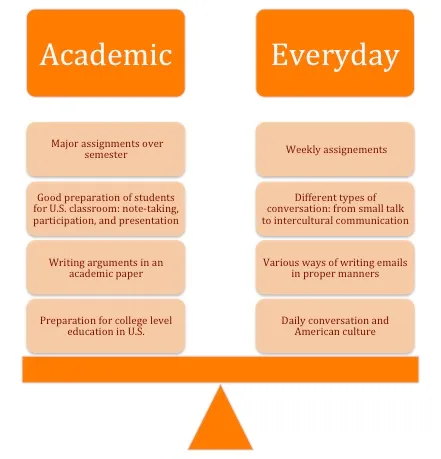
In academia, nothing is assumed. Everything must be earned on the page.
This isn’t about being difficult. It’s about how knowledge works in academia: claims need to survive scrutiny from people who weren’t there when you had your insights.
Five Core Differences
The gap between everyday and academic writing runs deeper than vocabulary or tone. It’s structural.
Purpose
Everyday writing shares experiences. Academic writing proves claims.
When I write “research is hard,” that’s fine for a personal post—readers nod along. But in a paper, “conducting qualitative research in low-resource settings presents methodological challenges” is not a claim. It’s decoration. The real claim is: which challenges, why they matter, what I learned.
Reader
Everyday writing assumes a friendly reader. Academic writing assumes a skeptical one.
Your professor isn’t being mean when they write “unclear” in the margins. They’re reading the way every journal reviewer will read: looking for the weakest point where your argument could fail.
Meaning
In everyday writing, meaning emerges from the overall vibe. In academic writing, meaning must be precisely extractable.
“The results were interesting” works in conversation—your listener sees your face, hears your tone, shares the context. On paper, it’s empty. Interesting how? In what way? Compared to what expectation?
Structure
Everyday writing can be exploratory. Academic writing requires a logical architecture.
A blog post can meander, circle back, end with a question. An academic paper must build: each section justifies the next, each paragraph supports a larger claim, each sentence connects to the argument. Structure isn’t decoration—it’s how the reasoning works.
Language
Everyday writing is expressive. Academic writing is functional.
I don’t use technical terms to sound smart. I use them because “p < 0.05” communicates something precise that “probably not due to chance” doesn’t. The language isn’t there to impress—it’s there to eliminate ambiguity.
Academic writing is not expressive writing. It is functional reasoning in language.
The Trap Non-Native Writers Fall Into
I see this pattern constantly among early-career researchers from non-English backgrounds:
They think the problem is their English. So they:
- Use more complex vocabulary (assuming “academic” means “fancy”)
- Pack sentences with clauses (assuming “sophisticated” means “long”)
- Add hedge phrases everywhere (assuming “cautious” means “vague”)
- Copy sentence structures from papers they’ve read (without understanding why those structures work)
The result sounds academic. But it doesn’t communicate.
Because the real problem isn’t language—it’s that they’re still writing in everyday mode. They’re trying to sound academic instead of thinking academically.
Many writing guides distinguish between everyday communication and academic writing, for example: Purdue OWL
Most academic writing problems are thinking problems, not language problems.
The issue isn’t grammar. It’s that the writer hasn’t defined their claim precisely. They haven’t identified what their reader doesn’t yet accept. They haven’t structured their reasoning to move from accepted premises to new conclusions.
No amount of vocabulary will fix that.
Why AI Makes This Worse
This is where AI becomes dangerous if you don’t understand the difference.
AI models are exceptionally good at everyday writing. They can generate fluent, natural-sounding text that feels informative. They’ve learned the surface patterns of academic language: the phrases, the hedging, the formal tone.
But academic writing isn’t about sounding academic. It’s about:
- Making one specific claim clear
- Showing exactly why it matters
- Building an argument that holds under scrutiny
- Taking responsibility for what each sentence means
When I ask AI to “make this more academic,” it adds complexity without adding precision. It generates sentences that look like academic writing but don’t do what academic writing does.
If you feed it unclear thinking, you get fluent nonsense.
AI will happily generate fifteen variations of a vague claim. It won’t tell you the claim itself is the problem.
What This Means for Learning to Write
For years, I approached academic writing as a language challenge: learn better words, study grammar rules, memorize phrases. I was optimizing the wrong thing.
Academic writing isn’t advanced English. It’s explicit thinking on paper.
The skills that matter aren’t:
- Bigger vocabulary
- Complex sentence structures
- Academic-sounding phrases
The skills that matter are:
- Knowing precisely what you’re claiming
- Identifying what your reader will question
- Structuring reasoning so each step is justified
- Eliminating every point where meaning could be misread
This is why you can write perfect grammatical English and still sound unclear in an academic context. You’re using everyday writing logic in an environment that requires something different.
Before learning how to write better sentences, you need to learn how academic vs everyday writing actually works.
Which is what we’ll unpack next.
Comments
2 responses to “Academic vs Everyday Writing”
[…] Those belong to a different category altogether. Well, now you can understand through, ‘just write more’ seems to improve everyday writing instead of academic writing. […]
[…] Mistake 1: Writing Without a Clear Argument Structure […]