critical academic writing mistakes and a simple checklist to catch them early
“Your paper is unclear.” This is one of the most frustrating comments early-career researchers receive—not because it is harsh, but because it is vague.
What exactly is unclear? The language? The logic? The structure? The argument?
Most writers respond by doing what feels reasonable: they edit sentences, add references, polish grammar, and rewrite paragraphs.
Often, the comment comes back unchanged.
The problem is not effort.
The problem is that most academic writing issues reviewers call “unclear” are not language problems at all. They are thinking and structure problems that surface through language.
If you keep revising sentences without addressing these problems, the comment rarely disappears.
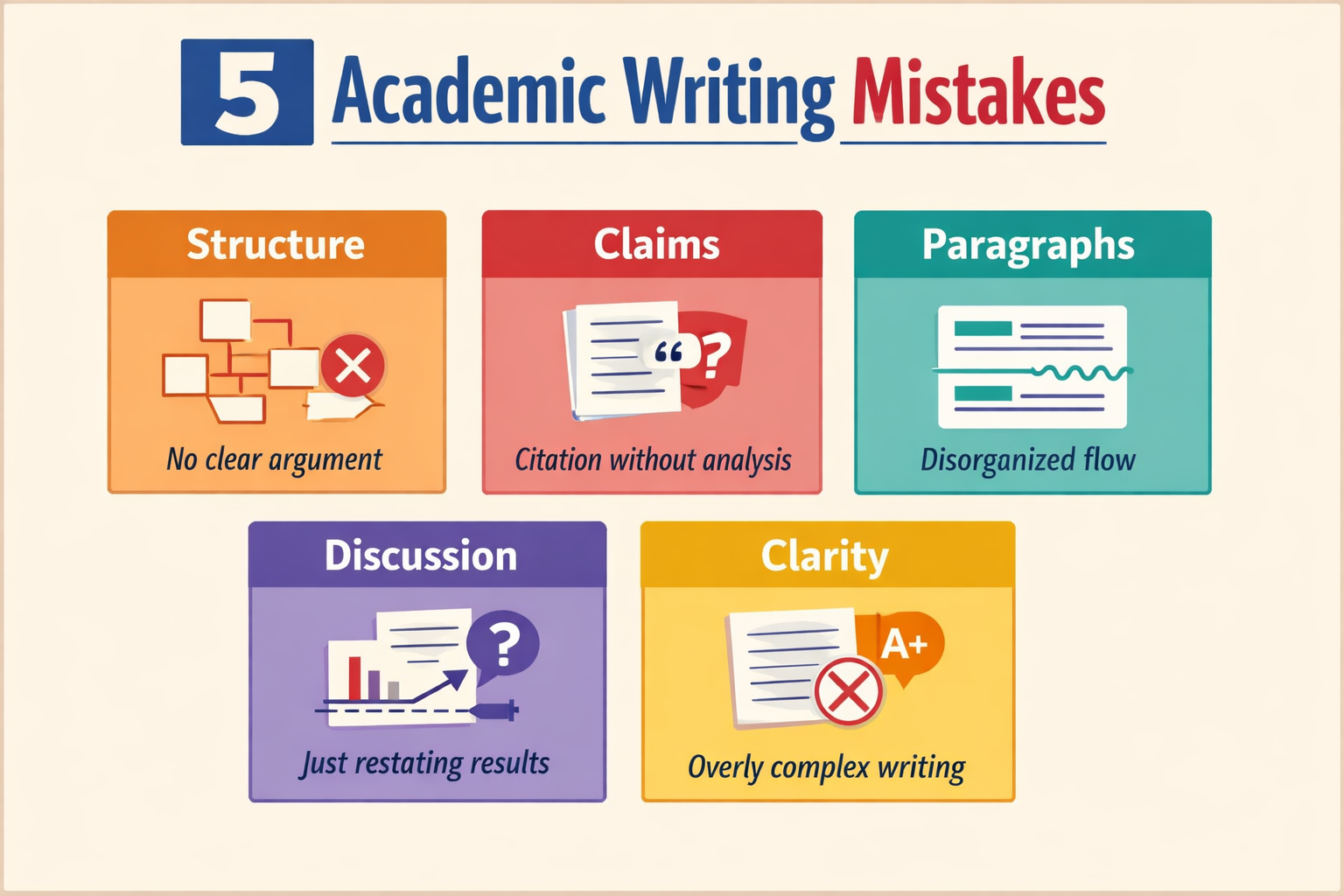
After hundreds of times re-write, below are five of the most common mistakes I see in academic manuscripts that are technically correct, grammatically sound—and still unclear.
Mistake 1: Writing Without a Clear Argument Structure
Many papers read like a collection of correct statements rather than a coherent argument.
Each sentence makes sense.
Each paragraph contains relevant information.
But the reader constantly asks: Why is this here?
This happens when writing is driven by content accumulation rather than argumentative necessity.
A useful diagnostic question is simple:
If I remove this paragraph, what part of my argument collapses?
If the answer is “nothing essential,” the paragraph is informational, not structural.
Clarity in academic writing does not come from saying more.
It comes from knowing what must be said for the argument to stand.
Mistake 2: Hiding Behind Citations Instead of Making Claims
Non-native writers, in particular, often hide behind references.
When unsure whether a claim is convincing, they add another citation.
When uncertain about interpretation, they cite multiple studies instead of articulating their own reasoning.
Reviewers do not see this as rigor. They see it as avoidance.
Citations support arguments; they do not replace them.
If a paragraph contains five references but no explicit claim, inference, or interpretation, the reader is left to do the thinking for you—and reviewers rarely appreciate that.
Mistake 3: Focusing Only on Sentence-Level Grammar
It is possible to write grammatically perfect sentences that are conceptually opaque.
Clarity in academic writing operates at multiple levels:
- sentence
- paragraph
- section
- manuscript
Most writers over-invest in the first and neglect the rest.
A paragraph can be composed of flawless sentences and still fail if:
- the topic sentence does not define the paragraph’s role,
- sentences do not build on one another,
- the concluding sentence does not resolve or transition.
Reviewers read for meaning, not syntax.
If they cannot track the progression of ideas, grammar becomes irrelevant.
Mistake 4: Writing Discussion Sections That Only Repeat Results
Many Discussion sections are structured around what was done rather than what was learned.
This results in sections that mirror the Results or Methods:
- restating findings,
- repeating statistics,
- summarizing tables.
The Discussion should answer different questions:
- What do these results mean?
- Why do they matter?
- How do they change understanding, not just confirm observations?
When discussion structure follows methodology instead of interpretation, reviewers often describe the paper as “descriptive” or “lacking insight.”
That is not a request for more data.
It is a request for deeper thinking.
Mistake 5: Trying to Sound Academic Instead of Being Clear
Academic tone is often misunderstood as complexity.
Writers lengthen sentences, nominalize verbs, and choose abstract phrasing to “sound scholarly.”
The result is prose that is technically academic but cognitively demanding for no reason.
Reviewers are experts—but they are also busy.
They appreciate writing that respects their attention:
- precise rather than ornate,
- direct rather than indirect,
- explicit rather than implied.
Improving academic writing clarity is not a stylistic weakness.
It is a professional courtesy.
A Simple Checklist for Academic Writing Mistakes
Before revising language or grammar, ask yourself:
- Does each paragraph serve a necessary role in the argument?
- Is my own reasoning explicit, or am I hiding behind citations?
- Can a reader summarize the main point of each paragraph in one sentence?
- Does the Discussion interpret results rather than repeat them?
- Am I writing to communicate, or to sound academic?
If several answers feel uncomfortable, editing sentences will not solve the problem.
The structure needs attention first.
What Writing Tools Can—and Cannot—Fix
Tools like Grammarly can help catch surface-level issues—typos, consistency problems, or overuse of passive voice. They are useful for final polishing, especially for non-native writers.
But no tool can diagnose missing logic or weak argumentation.
No tool can replace the work of deciding:
- what you are trying to claim,
- why it matters,
- and how each part of the paper supports that claim.
Those decisions belong to the writer.
Final Thought
When reviewers say “unclear,” they are rarely asking you to write more.
They are asking you to think more deliberately about what you are trying to say.
Clarity is not a polishing step at the end of writing.
It is a design choice made from the first paragraph onward.
What to Do Next
Print this checklist.
Use it on your current draft—before you revise grammar.
If most answers feel uncomfortable, you already know where the real problem is.