I started my thesis during my third year of Pediatric Surgery residency.
By then, I had what people usually assume is “enough” for research: medical training, familiarity with academic papers, and working knowledge of medical research methodology.
I had read textbooks on research design, attended lectures on study methodology, and memorized definitions of bias, confounding, and statistical tests. Yet when I actually sat down to do research, I felt completely lost.
Understanding the research workflow is essential for navigating complex projects.
Not confused in theory—disoriented in practice.
The real problem was not knowledge in the research workflow
At first, I assumed the problem was me.
Maybe I hadn’t read enough. Maybe my statistics were weak. Maybe my English wasn’t good enough.
So I did what most people do: read more papers, collected more references, tried to write sections whenever I found time.
None of it helped. What I gradually realized was this: I didn’t lack knowledge or language. I lacked a workflow.
No one had shown me—clearly and concretely—what research actually looks like when you’re doing it from start to finish.
What no one explicitly teaches
Of course, the environment we trained in required us all to read and learn many things related to the practical manifestation of science, but not everyone had enough analytical skills and deep understanding to see the big picture. And more than that, no one had a mentor/supervisor willing to sit down and discuss each tiny, seemingly trivial detail at every step of the research process. With AI, using just a basic prompt, I got an initial framework like this:
simple prompt after discussion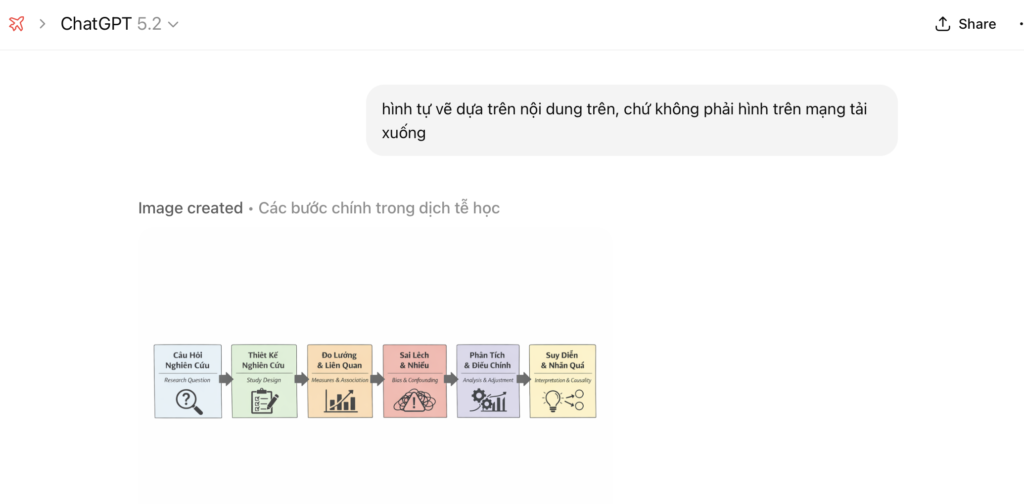
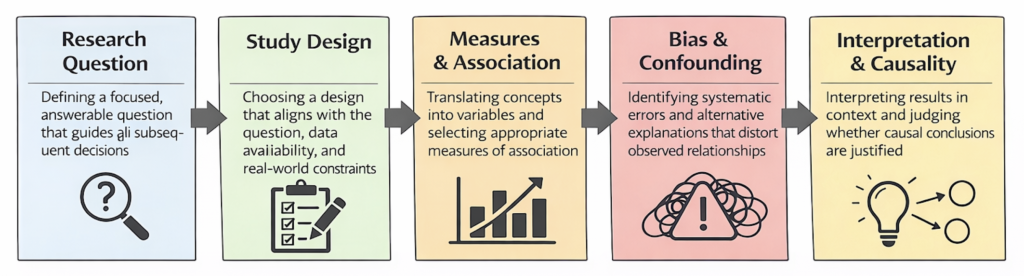
Yes, you can say this framework is basic, everyone knows it. In reality, when dealing with many people around me, I’m pretty sure more than half don’t really understand this process. And in practice, research isn’t experienced as a neat sequence. It’s messy, overlapping, iterative.
But in that messy situation, this framework serves as a map—it lets you navigate where you are in the long journey of completing a thesis. For example, I faced these problems (maybe you have the same)
- where to start reading
- when reading should stop and writing should begin
- how to move from vague interest to a precise research question
- how to keep notes in a way that later turns into writing
To be honest, in my country, residency supervisors are usually clinicians with limited epidemiology and methodology training. They didn’t have time to answer every amateur question from a newbie like me. I eventually completed my thesis through trial and error, but the struggle stayed with me.
Discovering flow, not tools
Years later, when AI tools became more accessible, I began experimenting—not to automate research, but to understand it better. Many early attempts failed. Some outputs were misleading. Others unusable.
But something unexpected happened.
By interacting with AI deliberately—asking it to help me summarize, reorganize, and question my own thinking—I started to see research differently. Not as isolated tasks, but as continuous flow:
reading to orient → reading to refine → writing to think → writing to clarifyAI didn’t give me answers. It helped me see the structure I’d been missing all along. For example, I used to read papers front-to-back, taking notes linearly. AI helped me see I could read strategically: abstract → discussion → relevant methods → selective results. This simple reordering saved hours.
You should try it—brainstorming and discussing with AI is genuinely engaging, even addictive. Yes, some models get overly enthusiastic (looking at you, GPT) or hallucinate details (Gemini, I see you). But in brainstorming, they can surface interesting problem-solving approaches and suggest possible workflows.
I wrote more about this realization in an earlier Substack post, describing research as a flow rather than a checklist.
Research as a living workflow
Once I began working with a clear workflow, several things changed:
- reading became purposeful instead of overwhelming
- writing became a thinking tool, not just a final step
- revision felt iterative, not punitive
Most importantly, I stopped blaming myself for “not being good at research.” The difficulty was never about intelligence or effort. It was about working without a map.
Why this matters
Many students and clinicians struggle with research not because they lack capability, but because they’re never shown how academic work unfolds under real conditions: limited time, incomplete guidance, overlapping responsibilities.
A clear workflow doesn’t simplify research—but it makes it navigable. Without a workflow, capable people quit research entirely— not because they can’t do it, but because the process feels impossible to navigate.
AI, when used responsibly, can support this by helping clarify thinking, making patterns visible, and supporting iteration without replacing judgment.
What this site will explore next
This site is built around that realization. Not as universal rules, but as workflows shaped by real academic work. The big picture is important, but then you have to face day-to-day execution. In future posts, I’ll break down:
- how to approach academic reading at different stages of a project
- how writing functions as a thinking tool, not just a reporting task
- where AI can help—and where it shouldn’t be used
Research becomes manageable not when you know everything, but when you understand how each step flows into the next.
Final point
Everything I share is based on my own experience. Your journey may differ, and I’d love to hear about it—please reach out if you have insights to share.