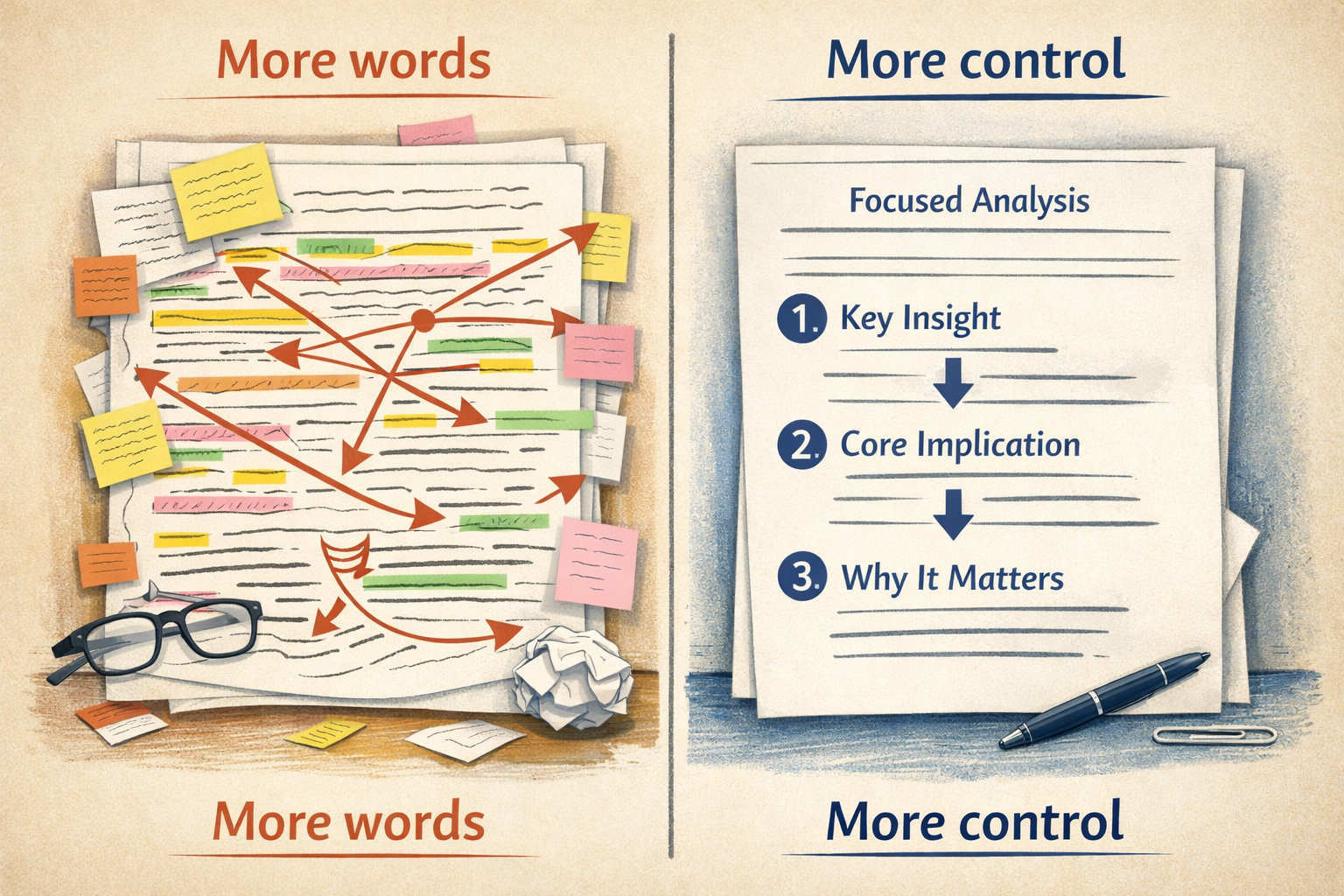
“Lack of depth” is one of the most common phrases editors and reviewers use—yet also one of the least explained.
Many authors assume it means not long enough, not cited enough, or not sophisticated enough. So they respond by adding words, references, or technical explanations.
And the paper still gets rejected.
The problem is not length. It’s not effort. And it’s rarely about missing information.
What editors usually mean by “lack of depth” is something much more structural—and once you see it, you can’t unsee it.
This article explains what “depth” actually signals to editors, why many papers look deep but aren’t, and what I had to change in my own manuscripts to finally stop hearing this phrase.
1. Why Editors Keep Saying “Lack of Depth” (But Rarely Explain It)
Editors use “lack of depth” as a shortcut diagnosis.
They are not writing a teaching note. They are making a fast decision under time pressure:
Does this manuscript feel controlled, positioned, and interpretable at a glance?
If the answer is no, “lack of depth” becomes a convenient label.
This is why the comment often appears in:
- desk rejections,
- early editorial decisions,
- or as a high-level reviewer remark without specifics.
From the author’s perspective, it feels vague—even unfair. From the editor’s perspective, it is efficient.
Importantly, this phrase is not a technical critique. It is a signal: “I don’t see enough evidence that the authors fully control the meaning of their work.”
Until you understand this, it’s easy to respond in the wrong way.
2. What “Depth” Means From an Editor’s Point of View
From an editorial standpoint, depth is not a property of sentences. It is a property of structure and positioning.
Editors do not read line by line at first. They scan the abstract, the figures, the section flow, and especially the discussion.
They are asking three silent questions:
Is there a clear interpretive spine? Do the authors decide what matters, or just report everything that happened?
Is the positioning explicit? Do I know where this work sits relative to existing literature—and why that position was chosen?
Is the logic constrained? Are claims bounded, prioritized, and justified—or does the paper expand in all directions?
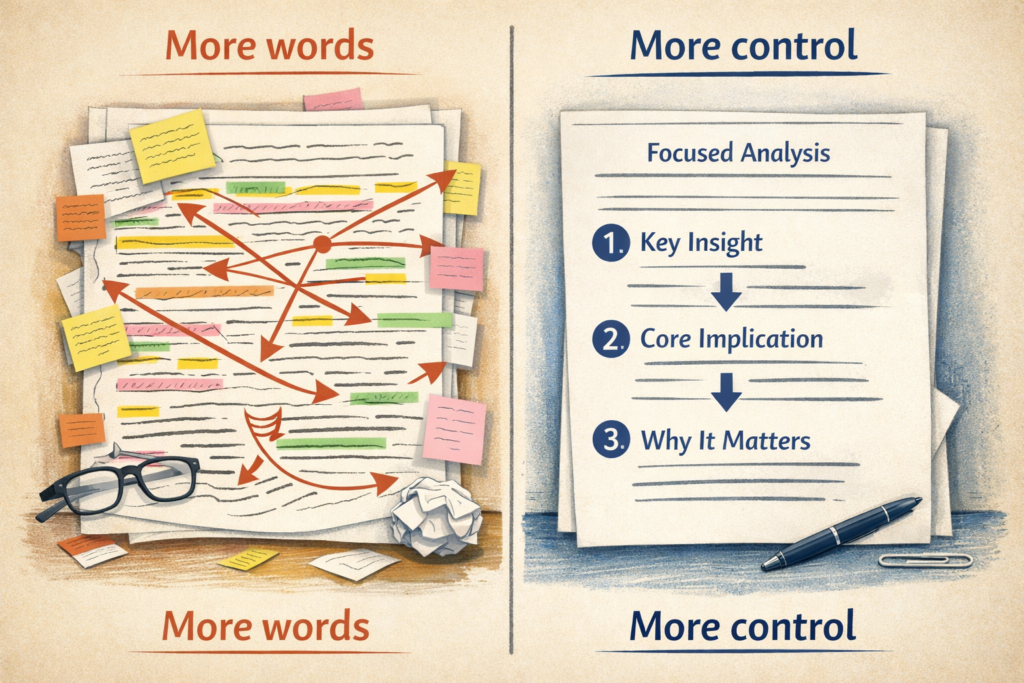
A manuscript can be long, well-cited, and technically correct—and still feel shallow if these signals are missing. Conversely, a relatively concise paper can feel deep if the decision logic is visible and controlled.
Depth, in practice, is about interpretive control, not informational density.
3. Where Most Papers Look Deep but Actually Aren’t
(And What I Had to Fix in My Own Papers)
This is the part most writing advice skips, because it’s uncomfortable.
3.1 The First Version I Thought Was “Deep Enough”
In early versions of my own papers, I genuinely believed depth was not the problem. The manuscripts had long discussions, extensive literature coverage, careful explanations of results.
On paper, they looked solid.
Yet the feedback kept circling back—explicitly or implicitly—to the same issue: lack of depth.
What I missed was that I was explaining too much and deciding too little. (You can read the post Just write more to get more information)
3.2 What Reviewers Didn’t Say (But Clearly Meant)
Reviewers rarely say:
“You failed to demonstrate interpretive hierarchy.”
Instead, they say things like:
- “The discussion is descriptive.”
- “The implications are unclear.”
- “The manuscript does not go far enough.”
What they are reacting to is the absence of visible decision points:
- Why this interpretation and not the others?
- Why this finding is central and that one secondary?
- Why this comparison matters in this journal context?
Without those decisions, the paper reads like a well-organized summary—not a controlled argument.
3.3 What I Changed (Concrete, Not Tips)
The shift was not stylistic. It was structural.
I stopped trying to:
- explain every possible angle,
- defend against every hypothetical critique,
- or mirror the literature section in the discussion.
Instead, I rewrote discussions around explicit decisions:
- Each paragraph answered one question: “So what does this change?”
- Literature was used to position, not to decorate.
- Alternative interpretations were acknowledged, then deliberately constrained.
Paradoxically, the discussions became shorter—and were finally perceived as deeper.
4. What “Depth” Actually Signals to Editors
When editors say “lack of depth,” they are looking for evidence that the authors are in control.
Depth signals that:
- the authors understand the stakes of their findings,
- they can prioritize meaning over completeness,
- and they know when to stop pushing a paper further.
This is why depth is judged most strongly in the discussion, not the results.
Results show what happened. Depth shows what it means—and why that meaning was chosen.
Once you internalize this, many confusing editorial decisions start to make sense.
What’s Next
In the next article, I will break down how I decide what actually belongs in the discussion under real constraints, and what to deliberately leave out—because depth is as much about exclusion as it is about insight.